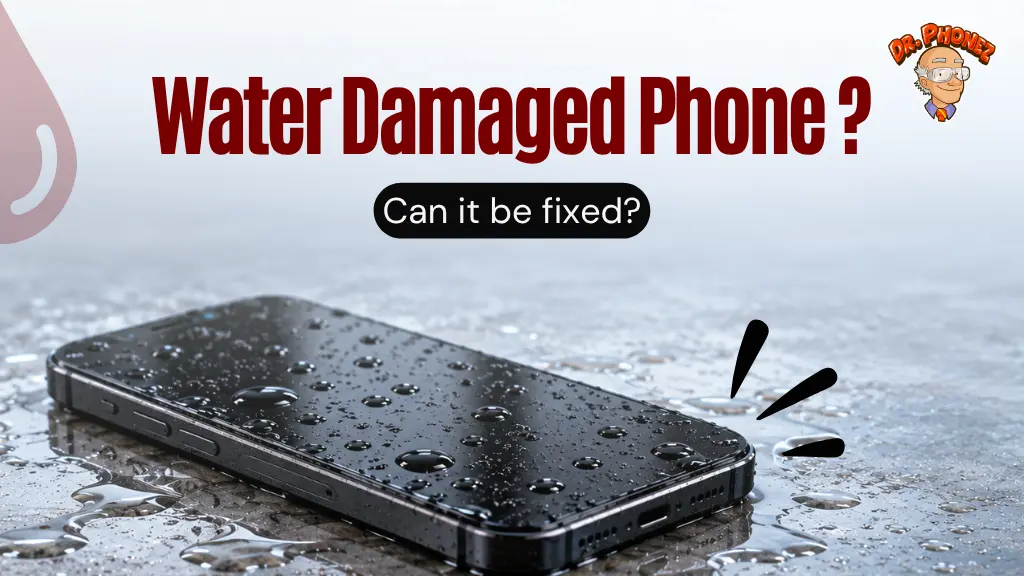
Yes, a water-damaged phone can often be repaired. But whether yours can be saved depends on three things: how quickly you act, what type of water it was exposed to, and what the water reached internally. The next 60 minutes matter more than anything a technician can do a week from now.
What Actually Happens Inside a Water-Damaged Phone
Most people picture water damage as a simple wet-equals-broken equation. The reality is more complex and more forgiving if you understand what is actually happening.
When water enters a phone, it does not immediately destroy components. What it does is create the conditions for destruction. Mineral deposits from the water begin coating the microscopic contact points on the motherboard, battery connectors, and charging circuits. As those deposits dry, they form a thin resistive layer that disrupts electrical signals. Then oxidation begins, which is the process most people call corrosion. Oxidation accelerates every time the phone is powered on while wet because electrical current flowing through a corroded path generates heat, which further accelerates corrosion.
This is why a phone that appears to work after water exposure is not a phone that has escaped damage. It is a phone where the damage has not yet become visible. In San Antonio’s climate, where average annual humidity is 67 per cent and summer temperatures often exceed 95°F, this process accelerates more quickly than in drier cities. Humidity means residual moisture lingers inside the device longer after the initial exposure, giving corrosion more time to develop before the phone shows any symptoms.
The delayed failure window is typically 24 to 72 hours. A phone that charged normally last night may refuse to turn on tomorrow morning. This is not bad luck. It is corrosion, a process that began the moment water entered the device.
Why IP Ratings Do Not Mean What Most People Think
iPhone and Samsung Galaxy flagships carry IP68 ratings, which creates a reasonable assumption that the phone can handle water. The reality is more limited than the rating suggests.
IP68 ratings are awarded based on controlled laboratory tests using fresh, still water at specific depths for specific durations. The test environment has nothing in common with real-world conditions. Chlorinated pool water from a day at Schlitterbahn or Six Flags Fiesta Texas is significantly more corrosive than fresh tap water. The Riverwalk is not a laboratory. A beach trip to Port Aransas involves saltwater, which is one of the most corrosive substances a phone’s internal components can encounter. Even carbonated drinks and coffee, which cause a disproportionate share of phone liquid damage, are more corrosive than the water used in IP rating tests.
Additionally, IP ratings apply to a new device with intact seals. A phone that has been dropped, repaired, or carried for over a year has seals that have degraded. The IP68 rating on a two-year-old phone with a replaced screen is largely theoretical.
Understanding this distinction changes how you respond when your phone gets wet, even if it “should” be fine based on its rating.
The First 60 Minutes: What to Do and What to Never Do
The actions taken immediately after water exposure determine the ceiling of what any repair technician can achieve.
Do these immediately: Power the phone off completely and do not turn it back on, even to check if it works. Remove the SIM card and case. Hold the phone with the ports facing downward and gently shake out any visible water. Place it in a dry environment with good airflow, not a sealed bag. If you have silica gel packets, place them nearby but not directly touching the device.
Never do these: Do not put the phone in rice. Rice does not absorb moisture from inside sealed electronics. What it does is introduce fine starch particles into the ports, adding a new problem to an existing one. Do not use a hairdryer or any direct heat source. Heat warps the internal components and drives moisture deeper into the board. Do not charge the phone. Applying electrical current to a wet device accelerates corrosion and can cause an immediate short circuit. Do not press buttons repeatedly to test if it works. Every electrical action while moisture is present increases damage.
The rice myth persists because phones occasionally recover on their own, independent of the rice, and the rice gets the credit. The honest reality is that rice does nothing a dry shelf cannot do, and a dry shelf does not contaminate your ports.
How Water Type Changes the Repair Outcome
Not all liquid damage is equal. The type of water involved significantly affects what a technician can and cannot recover.
Fresh tap water causes the least internal damage and responds best to professional cleaning. Most freshwater exposures, treated within a few hours, have a strong recovery rate.
Chlorinated pool water is more corrosive than fresh water and attacks copper traces on the motherboard more aggressively. Recovery is possible but requires more thorough ultrasonic cleaning and a longer diagnostic window.
Saltwater is the most destructive liquid a phone can encounter. Salt accelerates oxidation at a rate that can make a device unrecoverable within hours of exposure. If your phone was dropped in seawater or ocean surf during a trip to the Texas coast, the urgency of getting it to a repair shop is significantly higher than a kitchen-sink incident.
Other liquids, including coffee, juice, and soft drinks, leave sugar and acid residues that bond to internal components and require specific cleaning agents to remove properly. These cases are often more damaging than freshwater despite feeling less serious.
What Professional Water Damage Repair Actually Involves
Most people have no idea what happens when a technician opens a water-damaged device. Understanding the process helps set realistic expectations.
The first step is a full disassembly and visual inspection under magnification. A technician looks for corrosion patterns, liquid contact indicators that have activated, and moisture residue on the board and connectors. This diagnostic determines whether cleaning is likely to restore function or whether specific components need replacement.
Ultrasonic cleaning is the most effective tool available for water damage. The device’s internal components are submerged in a cleaning solution and subjected to high-frequency sound waves that dislodge mineral deposits and corrosion from surfaces a brush or cloth cannot reach. This is categorically different from any home remedy.
After cleaning, components are inspected again and tested individually. Batteries exposed to liquid are always replaced regardless of apparent function, because a water-exposed battery presents a swelling risk over time. Charging ports, flex cables, and speaker assemblies are assessed and replaced where necessary.
Data recovery is attempted in parallel when the device is not powering on. In many cases, the storage components survive even when the motherboard does not, and data can be transferred to a replacement device.
The Repair vs Replace Decision Framework
Not every water-damaged phone is worth repairing. Here is an honest framework for making that decision before committing to a repair cost.
A repair is likely worth pursuing if the device is less than two years old, the liquid exposure was brief and in fresh or tap water, the phone powered off naturally rather than being manually switched off after submersion, and the repair cost is below 50 per cent of the device’s current replacement value.
A repair becomes less viable if the device is over three years old, the exposure involved saltwater or chlorinated water for more than a few minutes, the phone was powered on repeatedly after the exposure, or visible corrosion is present on the charging port or SIM tray.
Even when a full repair is not viable, data recovery often is. The storage chips in most modern smartphones are the last components to fail, and a technician who cannot restore a device to working condition may still be able to retrieve the photos, contacts, and files from it.
Frequently Asked Questions
Can a water-damaged phone be saved? In many cases, yes. Success depends on how quickly the phone reaches a technician, what type of liquid it was exposed to, and whether it was powered on after the exposure. Phones treated within a few hours of fresh water exposure have a strong recovery rate. Saltwater exposure requires significantly faster action and has a lower overall recovery rate.
What should I do immediately after dropping my phone in water? Power it off immediately and do not turn it back on. Remove the SIM card and case. Hold its ports down and shake out visible water. Place it in a dry, ventilated space. Do not use rice with it, heat it, or charge it. Get it to a repair shop as quickly as possible, ideally within the same day.
Does rice actually work for water-damaged phones? No. Rice does not draw moisture from inside sealed electronics. It introduces starch particles into ports and creates a false sense of action. The only thing that actually removes internal moisture and addresses corrosion is professional ultrasonic cleaning.
How long does it take for water damage to destroy a phone? Visible symptoms can appear anywhere from immediately to 72 hours after exposure. The delayed failure window is why phones that appear to work after getting wet can fail days later. In humid environments like San Antonio, residual internal moisture lingers longer and extends the corrosion window.
How much does it cost to fix a water-damaged phone? Cost varies significantly based on the extent of internal damage, the device model, and which components need replacement. A diagnostic at a reputable repair shop establishes the actual cost before any work begins. Many shops offer free diagnostics specifically for water damage cases, which means you understand the situation before committing to anything.
Will a water-damaged phone work again? Often yes, particularly with early intervention and professional cleaning. However, water damage cannot always be fully reversed, especially when corrosion has reached the motherboard or core logic components. A professional diagnostic gives you an honest answer specific to your device rather than a general probability.
Phone Got Wet? Time is the most important variable.
Dr Phonez, we offer free water damage diagnostics at our San Pedro Avenue and Stone Oak locations in San Antonio. Walk in without an appointment, and our technicians will open the device, assess the damage, and give you an honest picture of what can be recovered before any repair costs are agreed upon. The sooner you bring it in, the more options you have.